
Affordable Managed Wi-Fi for Small Businesses in Georgia: 5 Low-Cost Options Reviewed

Spotty Wi-Fi can freeze your point-of-sale, frustrate guests, and steal hours you never budgeted for tech support. In 2024, that headache is optional.
Georgia just put $234 million into rural fiber across 28 counties, boosting speeds from Seminole to Gordon County, according to a January 2023 press release from the governor’s office.
Providers now bundle cloud-managed routers, mesh access points, and security filters in simple monthly packages. We tested them and picked the five best deals.
This guide shows where each service shines, what it costs, and how to choose the right fit for your floor plan and budget.
How we picked the winners
We started with every managed-Wi-Fi offer we could find in Georgia: big telcos, cable outfits, rural co-ops, and niche fixed-wireless players. Then we scored each one on five factors owners care about most: price, features, performance, support, and contract flexibility.
Price carried the most weight. If the monthly bill strains a small-business budget, fancy hardware means nothing. Features came next. We relied on the latest industry roundup from Clouddle to verify claims about Wi-Fi 6 radios, mesh coverage, and built-in security filters.
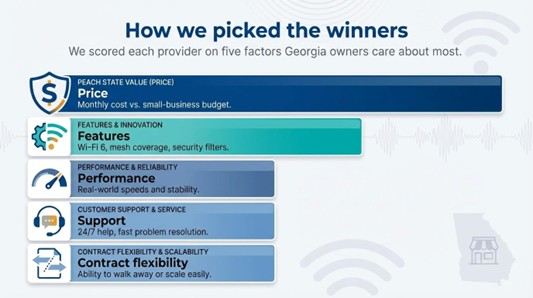
Performance and support mattered, but only after cost and capability. No one wants fast speeds paired with a two-hour hold queue. Finally, we rewarded providers that let you walk away without penalties or add access points on demand.
After the math, five services stood out. Each excels in a different sweet spot—overall value, no-contract freedom, strong security, multi-site control, or rural reach. They are the ones worth your time.
Georgia’s Wi-Fi moment: local needs and 2024 trends
Georgia businesses face widely different connectivity challenges. Midtown Atlanta startups crave gig-speed fiber for video calls and AR demos. A boutique in Blue Ridge just needs steady coverage so every card swipe clears the first time. Until recently, rural owners settled for shaky DSL or satellite lag.
That is changing.
The state’s broadband push, anchored by the $234 million in grants noted earlier, is laying fresh fiber in 28 counties and adding fixed-wireless towers in many more. Even towns with a single flashing stoplight can now order business-class bandwidth and the managed Wi-Fi layers that ride on top.
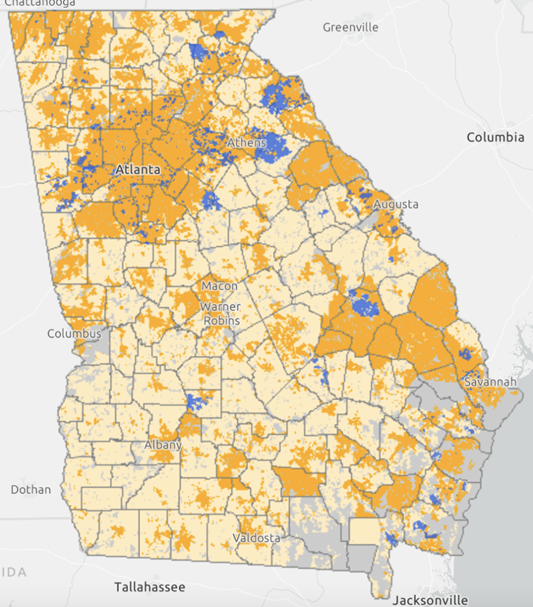
Georgia broadband expansion map showing 28 grant-funded counties and rural connectivity improvements
Hardware has also caught up with small-business budgets. Wi-Fi 6 gear that once sat in enterprise closets now ships inside the gateways cable and telco crews install daily. Extra capacity matters when your POS tablets, security cameras, guest phones, and a dozen smart light switches all demand airtime.
Security is higher on the checklist too. Insurance carriers now ask whether you isolate guest traffic and block malicious domains before quoting a cyber policy. Providers answered by baking threat filters and traffic analytics into their monthly bundles, removing one more chore from your plate.
Finally, 5G fixed wireless has become a credible backup or even a primary link. In metro corridors, a small antenna on the window can pull down more than 200 Mbps without trenching. For cash-strapped shops, that option keeps expansion costs in check.
Taken together, 2024 is the first year Georgia entrepreneurs can choose from several affordable paths to professional Wi-Fi, no matter the ZIP code.
WOW! Business: best overall value
If you are inside WOW! Business's Georgia footprint (Columbus, Newnan, or parts of Augusta), you can get enterprise-style Wi-Fi for roughly the cost of a team lunch. For owners who wonder whether the gear they buy today will keep up when a second storefront or dozens of new devices come online tomorrow, WOW!’s guide, Scalable Wi-Fi Solutions for small businesses, shows how its Whole Business WiFi expands alongside employees, devices, and added locations without a costly rip and replace. The post also breaks down how reliable coverage, built-in security, and an intuitive dashboard stay affordable for shops that cannot justify an IT department.
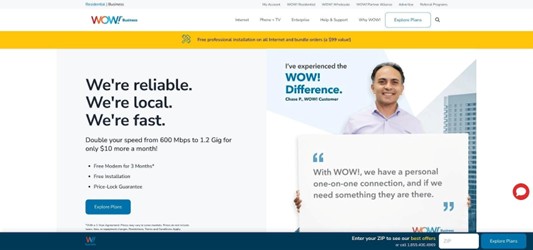
WOW! Business Whole-Business Wi-Fi managed service webpage screenshot
WOW!’s Whole-Business Wi-Fi bundles a mesh kit, pro installation, and 24/7 support into one predictable monthly add-on. A technician walks the floor, installs as many nodes as your square footage needs, and leaves you with wall-to-wall coverage.
Security runs quietly in the background. Guest traffic stays fenced off from your POS and back-office devices, and firmware updates land automatically. If a camera or tablet drops offline, you receive an alert before customers notice.
Day-to-day control lives in a clean mobile app. Change the password, see who is hogging bandwidth, or pause a troublesome device without calling IT. When questions pop up, you speak with a regional support team that knows Georgia quirks; useful when a 1920s brick wall tries to absorb your signal.
Pricing varies by speed tier but typically adds only a modest bump to an existing WOW! internet bill. For a small retailer or café, that extra line item beats buying hardware outright and hoping nothing breaks.
Bottom line: if WOW! serves your street, this package delivers the richest mix of coverage, security, and hometown support for the dollar.
Spectrum Business: best no-contract flexibility
Need Wi-Fi fast, with no long-term strings attached? Spectrum is the easy button.
Entry service in many Georgia ZIP codes starts around $49.99 a month for 400 Mbps, according to Business News Daily. The plan includes a modem, an Advanced Wi-Fi router, desktop security software, and custom email addresses, all without a multi-year commitment. Pay month to month and walk away whenever business needs shift.

Spectrum Business Advanced WiFi managed service webpage screenshot
Setup usually takes about an hour. Plug in, flip the sign to Open, and customers have a private guest network while your POS hums on its own lane. The router Spectrum provides is Wi-Fi 6, so it keeps dozens of laptops and phones talking at once without choking.
Because it is cable, peak-hour congestion can trim speeds. Spectrum’s portal offers basic visibility, great for changing passwords but light on deep analytics. If you want branded splash pages or heat-map coverage reports, look higher up this list.
Support is available 24/7 from U.S. agents, a relief at midnight when the receipt printer blinks “offline.” Even better, you avoid early-termination fees that often blindside small shops on tight cash flow.
For pop-ups, startups, or any Georgia business wary of contracts, Spectrum delivers respectable speed, no upfront hardware spend, and a quick exit if plans change.
Comcast Business: best built-in security and branded guest Wi-Fi
When your network touches customer data every few seconds, peace of mind is worth a few extra dollars. Comcast’s WiFi Pro package folds malware blocking, eight separate SSIDs, and a polished splash-page designer into one tidy add-on.
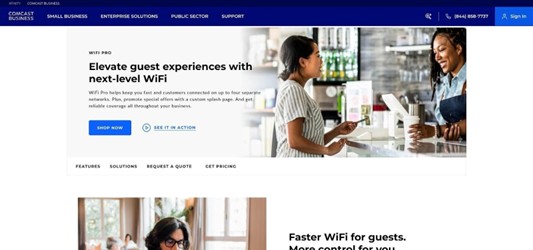
Comcast Business WiFi Pro branded guest Wi-Fi and security webpage screenshot
Setup starts with a Wi-Fi 6 gateway. A technician walks you through naming each network—staff, POS, cameras, and guests—so traffic never mingles. SecurityEdge then filters every request against a constantly updated threat list. Viruses and phishing sites stop before anyone can click.
Owners who value marketing perks will like the captive-portal tool. Drag and drop your logo, collect guest emails, and set session timeouts without writing code. It is a small sample of enterprise hospitality Wi-Fi, minus the five-figure invoice Clouddle cites for larger venues.
Pricing runs about $50 for entry-level internet plus roughly $20 for WiFi Pro. Contracts are standard one- or two-year terms. Read them closely; Comcast renews automatically if you miss the notice window.
Support is business-class, not residential. Call the 800 line and reach a rep who speaks static IPs and VLANs. For medical offices, law firms, or any Georgia shop that handles sensitive data, the always-on defense layers and professional help desk justify the modest premium.
AT&T Business: best for multi-location control
Growing beyond one storefront? AT&T’s Managed Business Wi-Fi keeps every site on the same playbook, whether you run two coffee bars or a dozen clinics.
Enterprise-grade Cisco Meraki gear sits in each location and reports to a single cloud dashboard. Open the portal and you see every access point on a live floor map, down to which iPad is hogging bandwidth. Need to change the guest password or check signal health in Macon? Click once, push settings everywhere.
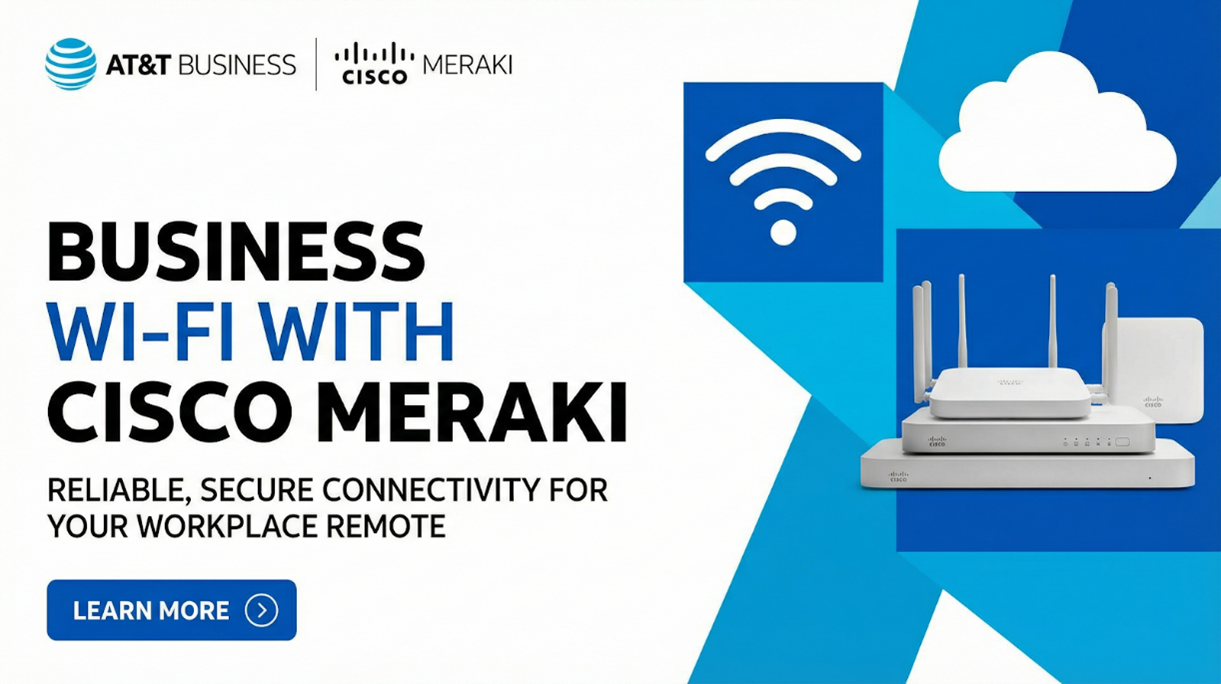
AT&T Managed Business Wi-Fi with Cisco Meraki dashboard webpage screenshot
Because the system is carrier-agnostic, you are not locked to AT&T circuits at every address. A strip-mall store on Comcast can still join the fleet, yet one vendor still handles Wi-Fi policies across the brand. Clouddle highlights that flexibility as a standout for franchises and fast-growing retailers.
Fiber plans in Georgia start near $70 for 300 Mbps. Add about $15–$30 per month per access point for the managed layer. Contracts span one to three years, and AT&T often pairs them with price-lock guarantees and LTE failover so a construction mishap cannot take down card readers.
Support is available 24/7 through priority queues for business customers. Pair that help desk with top-shelf hardware and a clear view of every store, and AT&T shines as the upgrade path when your Wi-Fi must grow as fast as your customer list.
Windstream Kinetic: best for rural reliability
Many Georgia towns sit outside cable footprints and gig-fiber grids, and that is where Windstream’s Business Ready Internet helps.
The bundle includes a solid broadband line (fiber where available, high-speed DSL elsewhere) and a managed Wi-Fi gateway that spins up separate employee and guest networks as soon as it powers on. A firewall blocks sketchy traffic, and automatic LTE failover steps in if a backhoe slices the main line. You keep ringing up sales even when the lights flicker.
Windstream prices the kit at about $99 a month with installation included. The rate is higher than our urban picks, but remember you are buying internet, Wi-Fi gear, security, and backup under one roof. For a hardware store in Hazlehurst or a doctor’s office in Dahlonega, that simplicity beats a cheaper piecemeal setup.
Contracts usually span three years, and the price stays flat the entire term. Local technicians handle on-site support, a perk rural owners rarely enjoy. Need stronger coverage in the stockroom? They will add an access point and tune channels so neighbors’ networks do not bleed over.
If shaky links have held your business back, Kinetic’s all-in-one package is a quick route to stable, secure Wi-Fi beyond the big-city limits.
How the five stack up at a glance
If you skimmed the reviews for the quick answer, here it is.
WOW! wins on overall value when price, mesh coverage, and local service carry equal weight. Spectrum sets the pace on flexibility with its month-to-month plan. Comcast layers in the strongest built-in security and the most polished guest tools. AT&T supplies the cleanest single-dashboard control for chains and franchises. Windstream delivers dependable Wi-Fi where cable vans never roll.
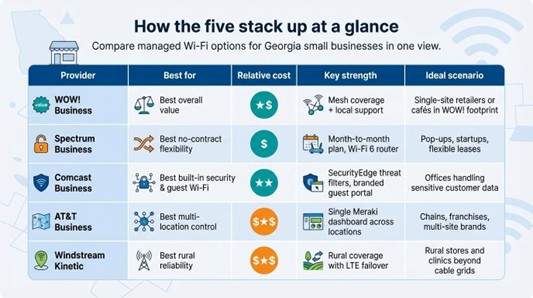
In raw dollars, Spectrum’s entry package is the least expensive path to managed Wi-Fi. Add about twenty a month and you can upgrade to Comcast’s security filters or WOW!’s mesh kit, both still solid bargains. AT&T and Windstream cost more upfront, yet they include enterprise hardware or rural backup that others leave out.
Your perfect fit comes down to two questions: Do you need the absolute lowest cost, or do you need capabilities like multi-site dashboards or LTE failover? Pick the column that matches your priorities and call that provider first. The homework is already done.
Frequently asked questions
Do I have to change internet providers to get managed Wi-Fi?
Not always. WOW!, Spectrum, and Windstream bundle Wi-Fi with their own circuits, so you subscribe to their access lines. AT&T’s Meraki service is different; it can run on a competitor’s broadband. Comcast sits in the middle, preferring a Comcast loop for WiFi Pro but still able to manage a separate backup link.
How hard is installation?
For the five options in this guide, setup is either technician-led or a guided self-install that takes under two hours. You point at the dead zones, the installer handles the rest. No ladders or cable fishing on your weekend.
Can I add more access points later?
Yes. Each provider lets you scale by calling support or ordering extra nodes in the customer portal. They arrive pre-configured, so the new hardware slides into your mesh with minimal downtime.
Will these services support a static IP or special port forwarding?
They will. Static IP addresses, VPN pass-through, and custom firewall rules are part of the business feature set. Just flag the need during signup so the tech provisions the right gateway.
Is Wi-Fi 6E or Wi-Fi 7 worth waiting for?
For most cafés, boutiques, and offices, Wi-Fi 6 already handles more devices than you own. 6E and Wi-Fi 7 add extra channels and speed, but they matter only when your laptops, phones, and tablets support them. If your provider refreshes gear every few years, you will catch the upgrade when it truly benefits you.
Conclusion: DIY Wi-Fi or managed service
You could buy a $300 router, screw it to the wall, and call the job done. Plenty of tech-savvy owners start that way. The hardware cost feels low, updates are a quick YouTube search, and no monthly fee shows on the balance sheet.
The trouble starts when a firmware patch bricks the router at lunch rush, or when a regular asks why your “guest” network lets her phone see your receipt printer. Every hour you spend Googling port-forward settings is an hour you are not selling lattes or chasing invoices.
Managed Wi-Fi flips that equation. For a modest bump on the internet bill, a technician tunes antennas, separates staff from shoppers, and pushes security updates while you sleep. If lightning zaps an access point, you dial a number and a fresh unit arrives instead of a Saturday Home Depot run.
Over two years, DIY out-of-pocket might land a few hundred dollars cheaper on paper. Factor in lost sales during an outage, plus labor you pay or sweat equity you donate, and the ledger tilts the other way for most Georgia small businesses. In short, if your core product is anything other than IT support, letting a provider babysit the network frees up profit and sanity.


Posted by inGenium Ltd

iNGENIUM Ltd. is an software development company from EU which delivers a full range of custom .NET, web and mobile solutions for different business to meet partner's demand.
The Power of Imagination Makes Us Infinite
Related Posts


Struggling to get your profile noticed no matter how often you post?

Imagine craving a beef burger really badly. So, you end up searching all the nearby restaurant options. What is the one thing that helps you decide where to order from?

The growth of digital advertising has unlocked countless opportunities but also introduced significant risks for modern marketing teams.

Few things test your patience quite like a printer that refuses to cooperate when you're in a rush.

Staffing shortages are squeezing hotels on both sides of the Atlantic.






Comments
comments powered by Disqus