
What is React Native? A complete guide to React Native app development

Have you ever wondered how major apps like Facebook, Instagram, and UberEats run seamlessly on both iOS and Android?
The answer lies in React Native—a JavaScript framework created for cross-platform mobile app development. Businesses worldwide rely on it to build fast, adaptable applications without sacrificing performance. But how does React Native programming language work, and is it the right choice for your app? This guide breaks down React Native meaning, its key benefits, and how it compares to traditional development.
What is React Native?
React Native is an open-source framework developed by Facebook that enables developers to build cross-platform mobile applications using JavaScript. Unlike traditional native development, which requires separate codebases for iOS and Android, React Native allows a single codebase to run on both platforms while maintaining a native-like experience. As of 2023, React Native is utilized by approximately 35% of global developers, making it one of the leading frameworks for cross-platform mobile development according to Statista.

Source: Statista
At its core, React Native is built on React, a JavaScript library designed for web development. Instead of using web components, React Native utilizes native UI components, which leads to smoother animations and better performance in comparison to conventional hybrid frameworks such as Cordova or Ionic. Its bridge mechanism allows JavaScript to communicate with native APIs, which enables access to features such as the camera, GPS, and push notifications without extensive platform-specific coding. This flexibility makes it a preferred choice for businesses that seek React Native app development services to create high-performance mobile applications while optimizing development time and costs.
How to hire React Native developers
Since React Native language is one of the most widely used frameworks for mobile development, the demand for experienced developers is high. Companies looking to scale their development teams should prioritize candidates with a strong grasp of JavaScript, TypeScript, React, and native development (Swift/Kotlin) for seamless integration with platform-specific features.
When hiring, businesses can explore multiple options, from freelancers and outsourcing agencies to in-house teams. The best approach depends on the project’s scope and complexity. Startups and small businesses often turn to freelance marketplaces or dedicated React Native development agencies, while larger enterprises may benefit from hiring full-time developers to maintain long-term projects.
For companies that build their mobile teams from scratch, it’s important to adhere to optimal practices on how to hire mobile app developers, making sure that candidates have the necessary skills while also fitting with the company's development strategy and operational workflow.
How does React Native work?
React Native operates through a layered architecture that separates JavaScript logic from native execution. At the top level, JavaScript serves as the programming layer where developers structure components, manage state, and define user interactions. However, since JavaScript alone cannot directly manipulate native UI elements, React Native introduces an intermediary layer known as the bridge.
The bridge enables interaction between the JavaScript thread and native threads, so that UI elements, animations, and platform-specific functionalities run smoothly. In contrast to web-based frameworks that depend on DOM manipulations, React Native translates JavaScript code into native APIs, providing a smooth connection with features specific to each platform. This mechanism enables developers to incorporate features such as gestures, push notifications, and hardware access without requiring separate native implementations.
Rendering and UI components
React Native language follows a component-based structure similar to React for web development. Each UI element—whether a button, image, or text block—is represented as a React component. These components do not translate into traditional HTML but instead map directly to native UI elements on each platform.
To optimize UI performance, React Native utilizes a Virtual DOM approach. Instead of directly modifying the interface with each state update, it calculates differences between the current and previous UI states and then applies the minimal set of changes needed. This reduces rendering overhead and contributes to smoother transitions and faster UI updates, making applications feel more responsive.
Native modules and performance optimizations
While React Native provides a broad set of built-in APIs, some features—such as advanced graphics, complex animations, or low-level hardware interactions—require deeper integration with native code. For these scenarios, developers can extend React Native’s functionality using native modules, which allow JavaScript to communicate directly with Swift, Objective-C (for iOS), Java, and Kotlin (for Android).
React Native offers different optimization techniques, like delegating intensive computations to native threads and minimizing unnecessary re-renders. Methods such as memoization, lazy loading, and code splitting contribute to maintaining the productivity of applications, even as their complexity grows. Furthermore, using tools such as Hermes, a streamlined JavaScript engine designed for React Native, can help decrease app startup durations and improve runtime performance.
Asynchronous execution and background tasks
React Native processes JavaScript logic asynchronously, which allows applications to remain responsive while executing background tasks such as API requests, data synchronization, or animations. This approach prevents UI freezes and improves the overall user experience. By utilizing asynchronous execution patterns like Promises and async/await, React Native guarantees that operations such as retrieving data from an API or modifying application state do not hinder UI interactions.
However, certain tasks—such as background services, Bluetooth interactions, or real-time audio processing—may still require native implementations. In such cases, React Native allows seamless integration with native libraries, so applications can take full advantage of platform-specific capabilities while still benefiting from a shared JavaScript codebase.
React Native's flexibility in development
One of React Native’s primary advantages is its flexibility for different development needs. It lets teams build applications from scratch or add React Native gradually to existing native projects. Many companies adopt this approach, using React Native for specific parts of an application while keeping native development for performance-heavy sections. This hybrid strategy helps businesses reduce costs and accelerate development without losing functionality.
React Native’s hot reload feature speeds up development because code changes appear instantly, removing the need for a full application rebuild. This approach noticeably cuts debugging time and boosts developer productivity, allowing teams to test new features and incorporate improvements more quickly.
React Native offers a strong basis for contemporary mobile app development. It can be utilized for complete application creation or integrated into a hybrid strategy, and its versatility makes it a suitable option for companies looking to improve productivity while delivering top-notch mobile experiences.
When to use React Native
Not every app needs React Native, but for many projects, it can provide the ideal balance between cost, speed, and performance. Businesses looking to develop applications for both iOS and Android without maintaining separate codebases can take advantage of its cross-platform capabilities. With a JavaScript-based structure and access to native components, it’s a solid choice for companies that aim to streamline development while maintaining high-performance standards.
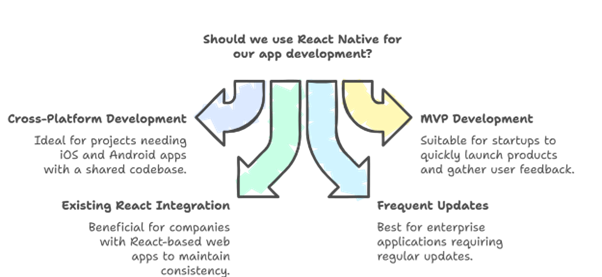
Source: napkin.ai
- React Native allows businesses to develop applications for both iOS and Android with a shared codebase. Unlike traditional hybrid frameworks that rely on WebViews, React Native compiles native code, offering near-native performance. This makes it an excellent option for apps that require smooth animations, fast rendering, and real-time interactions but don’t demand deep integration with platform-specific features.
- For startups and mid-sized businesses, React Native is particularly valuable for Minimum Viable Products (MVPs). Instead of investing in separate teams for different platforms, developers can quickly roll out features, gather user feedback, and iterate efficiently. This approach greatly speeds up time-to-market and also keeps costs fairly manageable.
- Companies with existing React-based web applications benefit greatly from React Native, as the framework shares core principles with React. Developers familiar with JavaScript and React can transition effortlessly, which can shorten the onboarding duration and maintain uniformity across platforms. This is why many organizations with web-first strategies integrate React Native into their ecosystem.
- Enterprise applications that require frequent updates and maintenance also see advantages. Features like over-the-air updates (via services like CodePush) allow developers to push changes instantly, bypassing lengthy app store review processes. This makes React Native an excellent choice for content-heavy apps, internal business tools, and customer-facing applications that demand continuous improvements.
However, while React Native covers most development needs, certain features—such as AR, intensive graphics, or complex background processing—may still require native modules. But if an app only requires partial native functionality (e.g., accessing the camera, GPS, or biometric authentication), React Native provides a seamless way to integrate some native modules without switching to full native development. Evaluating long-term scalability, performance expectations, and native dependencies will help determine if React Native is the right choice.
Conclusion
React Native provides a flexible and budget-friendly option for numerous mobile development initiatives, but its appropriateness relies on the complexity of the application and the requirements of the business. If a project prioritizes cross-platform consistency, rapid development, and flexibility, React Native is a strong contender. However, apps that demand extensive native functionality may require a hybrid approach or full native development.
FAQ
Can React Native be used for web development?
By default, React Native is designed for mobile applications, but with the help of libraries such as React Native Web, developers can adapt their codebase to run on web browsers. This allows businesses to reuse much of their existing React Native code to develop web applications, reducing development time and costs. However, since React Native was originally built for mobile, certain native components may not be fully compatible with web browsers, which can require developers to write additional platform-specific logic
Does React Native support offline functionality?
Yes, React Native supports offline functionality using a variety of local storage and caching solutions. Developers can store and retrieve data using AsyncStorage, which functions as a lightweight key-value store. For more complex offline storage needs, databases like SQLite, WatermelonDB, or Realm allow efficient querying and data persistence. Additionally, applications that need real-time data synchronization while offline can use libraries like Redux Persist or service workers that sync data once the device reconnects
Is React Native suitable for game development?
React Native is not the best choice for high-performance game development, especially for games that require intensive rendering, physics calculations, or real-time multiplayer interactions. Since React Native depends on a bridge to communicate with native modules, it introduces additional processing latency that can impact performance. However, for simple 2D games or casual mobile applications, React Native can be used alongside libraries like React Native Game Engine or Three.js for WebGL-based graphics. Some developers also integrate React Native with Unity or other game engines to handle game logic separately while keeping React Native for UI components like menus, leaderboards, or social sharing features.
Can React Native apps access native device features?
Yes, React Native supports native device functionalities such as the camera, GPS, Bluetooth, push notifications, and biometrics. Developers can access these features using React Native’s built-in APIs or third-party native modules. If a feature is not available, custom native modules can be written in Swift, Objective-C, Java, or Kotlin.


Posted by inGenium Ltd

iNGENIUM Ltd. is an software development company from EU which delivers a full range of custom .NET, web and mobile solutions for different business to meet partner's demand.
The Power of Imagination Makes Us Infinite
Related Posts


Struggling to get your profile noticed no matter how often you post?

Imagine craving a beef burger really badly. So, you end up searching all the nearby restaurant options. What is the one thing that helps you decide where to order from?

The growth of digital advertising has unlocked countless opportunities but also introduced significant risks for modern marketing teams.

Few things test your patience quite like a printer that refuses to cooperate when you're in a rush.

Staffing shortages are squeezing hotels on both sides of the Atlantic.







Comments
comments powered by Disqus