
Automated Job Application Tools: How to Pick the Right Platform for Your Search

Job hunting still devours your evenings—tweaking résumés, re-entering work history, clicking Apply on repeat.
In 2024 a single bot blasted 5,000 applications overnight and landed 20 interview requests, proof that automation can shoulder the grunt work. But raw volume isn’t victory: each platform juggles speed, match quality, price, and account safety differently. In this 2025 guide we unpack those trade-offs and compare the front-runners—like AIApply—so you can reclaim your nights while landing interviews that count.
Where job-search automation stands in 2025
Fresh capital is accelerating releases
Simplify closed a $3 million seed round on February 7, 2024 to build an “always-on AI career agent” that scrapes jobs, autofills forms, and drafts short-answer responses. Similar checks are landing across the sector, paying for faster matching algorithms and smarter document generation.
Consolidation has begun
Sonara paused new sign-ups in March 2024 and was acquired by résumé giant BOLD in July 2024. The deal signals that established career-tech players want auto-apply bots inside their product suites.
Quality now outranks quantity
First-wave tools bragged about hundreds of applications per hour. Newer entrants cap daily sends and add human review to curb mismatches—a direct response to recruiter surveys that blame spray-and-pray bots for inbox noise.
Compliance pressure is rising
Job boards are tightening API limits, and LinkedIn says it blocked 94.6 percent of fake accounts at registration in the first half of 2024 thanks to new automation detectors. Many auto-apply platforms now offer “safety modes” that randomize timing or require one-click approval; ignoring them risks account suspension.
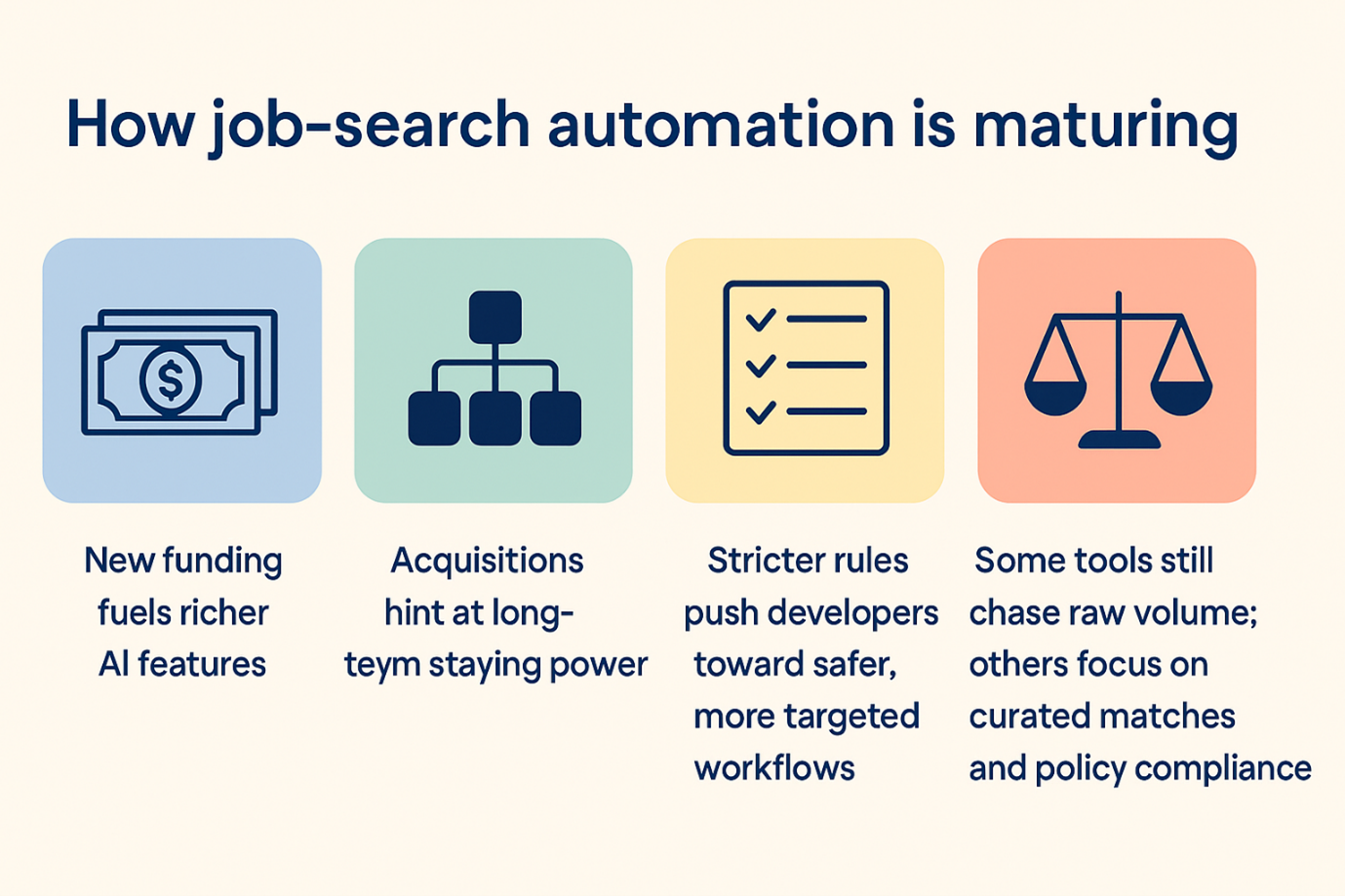
In short, job-search automation is maturing:
- New funding fuels richer AI features.
- Acquisitions hint at long-term staying power.
- Stricter rules push developers toward safer, more targeted workflows.
Some tools still chase raw volume; others focus on curated matches and policy compliance. For instance, auto-apply platforms like AIApply illustrate how newer tools prioritize targeted matching over sheer volume. The next sections group the options by the pain points they solve so you can choose the approach that fits your search style in 2025.
Platform for automated job application tools
AIApply — targeted reach without spam
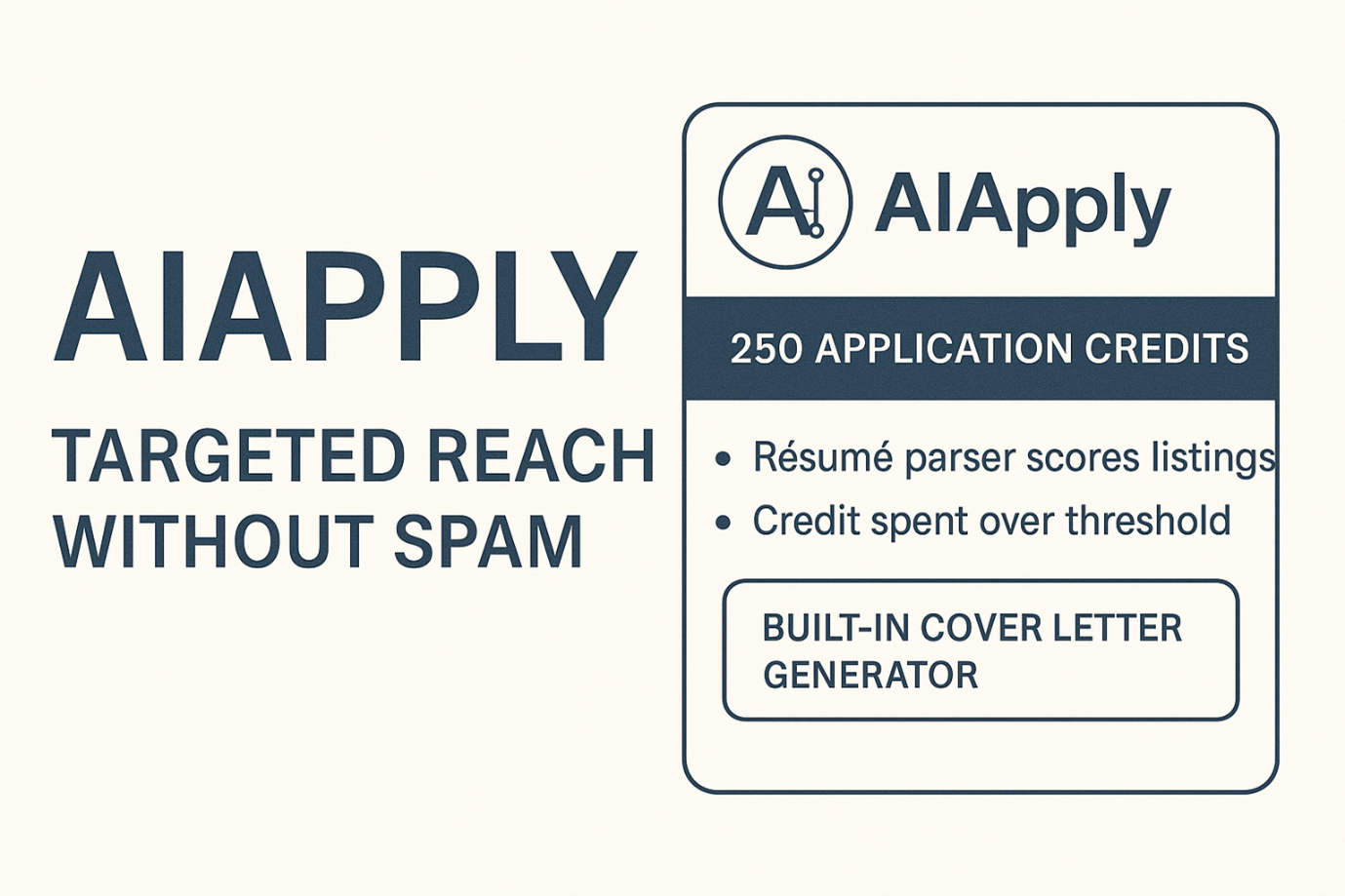
AIApply runs on a credit model: buy 100, 250, or 500 application credits (from $29 to $79) and use them whenever you want; unused credits never expire. A résumé parser scores hundreds of listings and spends a credit only when the match score tops a preset threshold.
Why it matters: 80 percent of users land at least one interview in the first month, according to the company’s onboarding survey. A built-in cover-letter generator rewrites your pitch for every post, keeping keywords aligned while sparing you the copy-paste grind. Pair that with Interview Buddy and you get an end-to-end assistant that favors precision over spray-and-pray volume.
Enhancv: polish in minutes, not hours
Enhancv began as a résumé builder and now includes GPT-4. Paste a job ad and the AI rewrites bullet points, then scores your résumé against the posting to close keyword gaps. Tools focused on résumé enhancement, such as Enhancv, fit this use case by tightening relevance without relying on high-volume automation. A seven-day free trial allows unlimited résumés; paid plans start at €14 per month and add real-time ATS checks plus a relevance-score dashboard. Users who once spent an hour tailoring a résumé now finish in under ten minutes, based on Enhancv logs from 300 000 scans.
LazyApply: one-click barrages
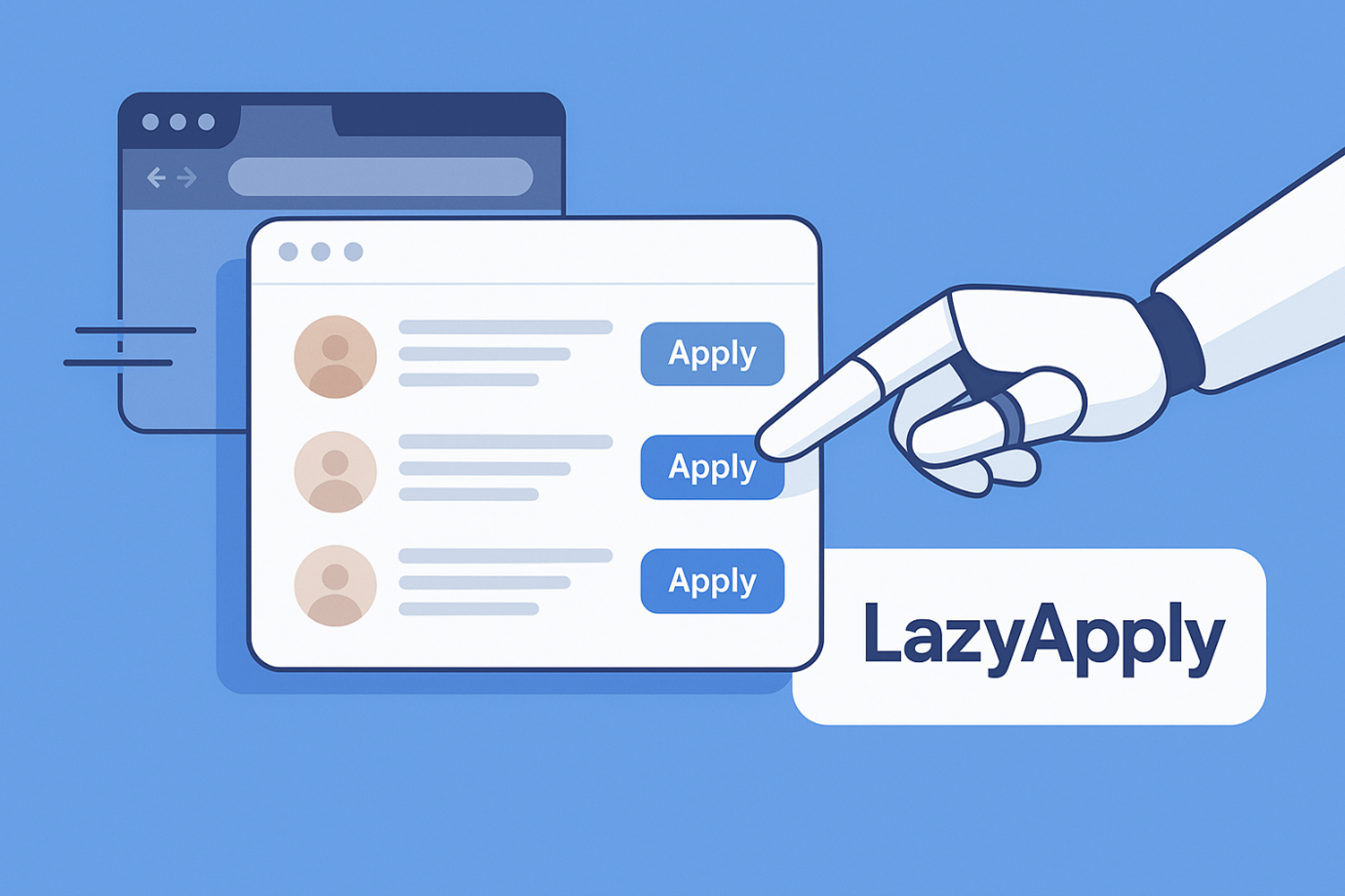
LazyApply’s Chrome add-on queues your search filters, then auto-hits LinkedIn, Indeed, and other Easy Apply buttons. Paid tiers range from 150 applications per day (Premium) to 1 500 per day (Ultimate). Users who bought the lifetime plan told Wired they sent about 5 000 applications overnight and woke to 20 interview requests. Catch: the bot fills every field exactly as stored, so an unexpected question can land in the wrong box and LinkedIn may flag unusual activity. Check the log and throttle runs when warnings appear.
LoopCV: drip irrigation, not fire hose

LoopCV crawls multiple boards each night, matches roles to your résumé, and submits up to 100 applications per month on its Standard plan or 300 on Premium. Spreading over days lowers detection risk and lets you A/B-test résumé variants in real time; retire any version that draws fewer callbacks.
Best suited for:
- Candidates pivoting to new industries who value exposure over precision
- Roles that use simple, repeatable forms
- Job seekers willing to accept some mismatches to save time
Sonara — concierge matching with human QA
Sonara combines an AI matcher with a human review team. The algorithm surfaces roles that fit your profile; staff then answer open-ended questions before submitting the application, catching prompts like “Describe a project that failed.”
The service paused sign-ups in March 2024 and relaunched under résumé giant BOLD four months later. Today Sonara offers two tiers: $49 per month for up to 120 applications and $79 for 420 applications, both with optional pre-send review. Users credit the hybrid model with cutting form errors and landing interviews in half the time they experienced with fully automated tools (median 18 days vs 36).
If one timely interview can justify the fee, Sonara’s human-in-the-loop approach may be worth the premium.
Wobo — a personal AI recruiter on a budget
Wobo is the newest entrant in smart-match suites, and its pricing attracts early-career tech candidates. The free plan lets you discover jobs and send up to 10 applications; paid tiers jump to 20, 40, or 160 applications per month at $24.99, $44.99, and $53.99. Each submission is drip-scheduled to mimic human timing and paired with a résumé variant that helps the bot slip past detectors.
Early reviews praise Wobo’s rewrite engine for flagging missing keywords and boosting ATS scores within a week. Mock-interview drills and market-insight emails round out the tool, making it closer to a full-cycle assistant than a single-feature apply bot.
Pick Wobo—or any smart-match suite—when you have a clear target title, pay band, and geography. Precision keeps your brand intact and frees hours you can invest in networking or skill building.
Simplify: autofill plus a personalized feed
Simplify’s free Chrome extension stores your profile and autofills applications on more than 100 job boards and ATS portals, including Workday and Greenhouse. The company says users submitted 200 million applications and saved 500 000 typing hours in 2025. A Copilot dashboard scores each posting against your résumé and tracks every submission—useful when you still prefer to choose roles one by one.
When a booster is the right call Choose Enhancv or Simplify when you want to hand-select openings but need professional-grade documents and zero busywork. Pair a booster with a smart-match or high-volume service to gain both precision and speed.
Scale.jobs: proof in every screenshot
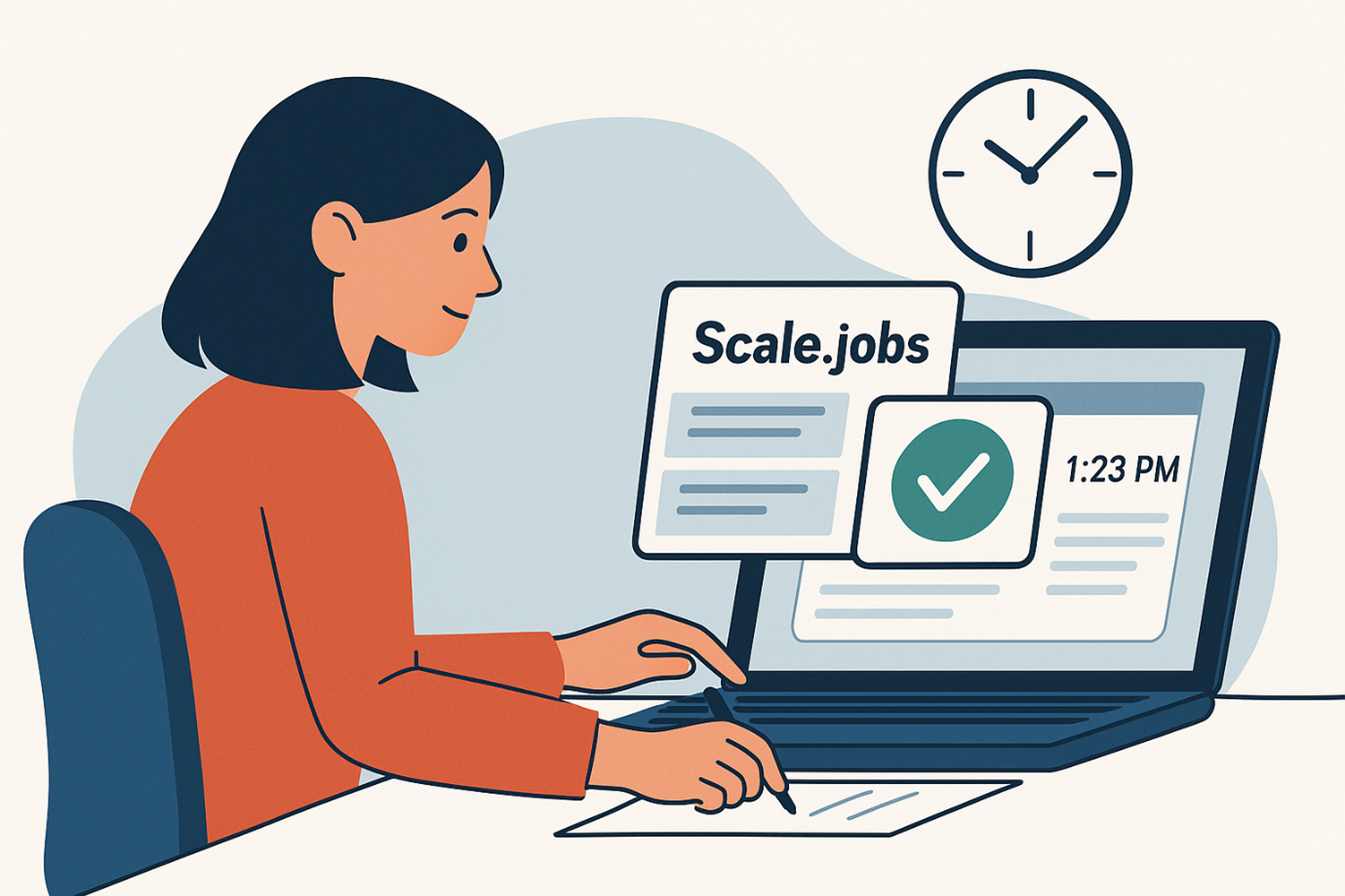
For a one-time fee of $199 to $399, Scale.jobs assigns a remote assistant who completes 250 to 1 000 applications and logs each one with timestamps and full-page screenshots. Because a person clicks every field, the service clears CAPTCHAs and government portals that stop most bots.
Find My Profession: full “reverse recruiting”
Executives can outsource the entire search: résumé rewrites, role research, and outreach. Packages start at $5 000 for three months, then $1 350 per additional month. The cost is steep, but a single six-figure offer can justify the spend.
Who gains most Choose a concierge service when stakes are high and mistakes are costly—government bids, C-suite moves, or visa-sponsored roles. You will pay more than for a DIY bot, yet you free time for interview prep, the one step no tool can automate.
Conclusion
Job-search automation won’t magically land your dream role while you sleep—but it can turn the slog of forms, uploads, and copy-pasting into a manageable, trackable system. The real win in 2025 isn’t blasting the most applications; it’s using automation to show up more consistently, with better-targeted résumés, on the roles that actually fit.
Treat these tools as force multipliers, not silver bullets. Let them handle repeatable work—rewriting bullet points, autofilling portals, drip-sending applications—so you can spend your best energy on what still moves the needle most: targeted outreach, thoughtful follow-ups, and strong interview performance.
How to choose your tool in five quick checks

1.Scope.
Do you only need autofill and document polish, or a platform that also drafts emails, tracks stages, and schedules interviews?
2.Board coverage.
Verify that the tool works reliably on the sites and ATS platforms your target companies use (LinkedIn, Indeed, Workday, Greenhouse, etc.).
3.Volume comfort.
Decide how many applications you can realistically track each week. Pick a tier that fits that pace so you’re not drowning in auto-replies.
4.Budget versus upside.
Compare subscription costs against potential salary impact. An $80 plan is easier to justify if it helps you land one offer with a $10 000 bump.
5.Transparency and safety.
Favor tools that log every submission, respect job-board rules, and offer safety modes or human review. Logs and screenshots protect both your accounts and your reputation.
If you choose a tool (or stack of tools) that aligns with your volume tolerance, budget, and target roles, automation stops being a gimmick and becomes leverage. That’s how you reclaim your evenings and land interviews that count.
Frequently Asked Questions
1. Can using auto-apply tools get my LinkedIn or job-board accounts banned?
It’s possible if a tool ignores platform rules or sends too many applications too quickly. That’s why many services now offer safety features like throttled sends, random delays, or one-click approvals. Use those modes, avoid 24/7 runs, and monitor for warning emails or CAPTCHA spikes.
2. Will automation hurt my chances because recruiters “can tell” it’s a bot?
Automation hurts you only when it creates bad matches or generic, off-target documents. High-volume, low-quality blasts are what frustrate recruiters. Smart-match tools and document boosters that keep applications relevant—and help you tailor your résumé or cover letter—can actually improve how you show up in their pipeline.
3. How many automated applications should I send per week?
There’s no universal number, but two constraints matter:
- Your bandwidth: How many leads can you track and follow up on without dropping the ball?
- Role competitiveness: Broad roles (e.g., generalist marketing) may require more volume; niche or senior roles benefit more from precision and outreach.
As a rule of thumb, use volume tools to keep a steady flow of 20–50 relevant applications per week, then layer in targeted networking for your top 5–10 roles.
4. What’s the main difference between high-volume tools and smart-match suites?
- High-volume “blasters” focus on speed and reach—hundreds to thousands of applications with minimal filtering.
- Smart-match suites score each job against your profile and only apply when the match is strong, typically with tailored documents.
If you’re early in a pivot and just need exposure, start with volume (carefully). If you know your target title, salary band, and geography, smart-match tools usually deliver better interview rates.
5. Do these tools replace networking and referrals?
No—and they shouldn’t. Automation shines on repetitive form-filling and basic tailoring. Referrals, warm introductions, and direct outreach to hiring managers still outperform cold applications for competitive roles. Use automation to free up time so you can network more, not less.


Posted by inGenium Ltd

iNGENIUM Ltd. is an software development company from EU which delivers a full range of custom .NET, web and mobile solutions for different business to meet partner's demand.
The Power of Imagination Makes Us Infinite
Related Posts


Struggling to get your profile noticed no matter how often you post?

Imagine craving a beef burger really badly. So, you end up searching all the nearby restaurant options. What is the one thing that helps you decide where to order from?

The growth of digital advertising has unlocked countless opportunities but also introduced significant risks for modern marketing teams.

Few things test your patience quite like a printer that refuses to cooperate when you're in a rush.

Staffing shortages are squeezing hotels on both sides of the Atlantic.






Comments
comments powered by Disqus